
Will High-Speed Rail Push Canada's Transit Planning Apparatus Past Its Breaking Point?
Reflections as Alto surges forward.

Alto is currently in the midst of hosting a number of open houses, where the Crown corporation is making their case to Canadians for high-speed rail. But even as much about the project remains undecided, its developers increasingly seem to be committing key missteps. At the same time, I sense the project is beginning to strain under the constraints placed upon it — constraints stemming from the frankly backwards way Alto is thinking about and planning to implement a project of this scale.
On top of all this, the lack of intelligent governance of rail and public transit in Canada—or at least in the Quebec City–Windsor corridor—ais setting Canada up to waste money on the project and its infrastructure, all while failing to offer things like open-access operations and high-speed rail–airport links that are common in Europe and Asia, meaning that even if Canada manages to build high-speed rail, it will lack many of the great features and learnings of high-speed rail that already exist in other countries today.
Missteps
High-speed rail projects are massive planning endeavours, and it’s hard to get everything right; at the same time, given their scale and the fact that few major city pairs are connected with two separate high-speed links (Beijing-to-Shanghai has been, Tokyo-to-Osaka will be, and Paris-to-Lyon might be someday), getting it right on the first go-around is crucial. And yet…
Alto is already making some questionable decisions. Despite not committing to a specific alignment, the project team seems to be committing to a range of possible alignments that altogether probably mean there will be both no direct connection to Montreal–Trudeau International Airport—and thus the high-speed line would not directly connect to any major international airports—and a new tunnel under Mt. Royal. (I discussed this at length in a previous article.)
Somehow such an alignment would be the worst of all worlds: We wouldn’t get the Trudeau connection by coming through the West Island, nor would we get the connectivity to those communities.
I am getting concerned now that CDPQ—which is leading the Cadence consortium—thinks the REM connections to the airport and West Island mean high-speed rail connectivity is less important, but I think they are plainly wrong.
Transit being interconnected is valuable, but there is a bit of an undervaluing of direct connectivity in recent Canadian transit history. For example: plans to have the Sheppard Subway in Toronto travel to Sheppard and McCowan instead of Scarborough Centre—where all the action and transit connections are—or Ottawa’s creation of a shuttle line to connect to its airport, and Calgary’s musing about something similar. Transfers work but should not stand in for what should be a direct connection. Taking the REM to the airport from the Alto alignment will almost certainly mean travelling back north from central Montreal; even just the geometry of that will discourage people from taking the trip. Similarly, requiring people on the West Island to get to the REM, then travel east to get to high-speed rail, to then finally travel west (a common trip for what I hope are obvious reasons!) is bad!
And you end up paying for a tunnel, but mostly just for access (sort of how high-speed rail from mainland China arrives in Hong Kong). And who knows—given that Alto likely won’t want to build a new tunnel very close to the existing Mount Royal tunnel (I wouldn’t if I was planning this service pattern!), maybe they won’t even have the necessary geometry at Centre-Ville to continue trains south along the REM in the future without additional and extremely expensive civil works. So we spend a tonne on a tunnel, but without the main benefit of a tunnel: through operation of trains (which might not ever be possible without more massive expenditure). It’s the kind of thing you probably wouldn’t do if you were watching New York get ready to almost build a similar new tunnel to access Manhattan, which would also end in a terminus instead of creating through-running opportunities.
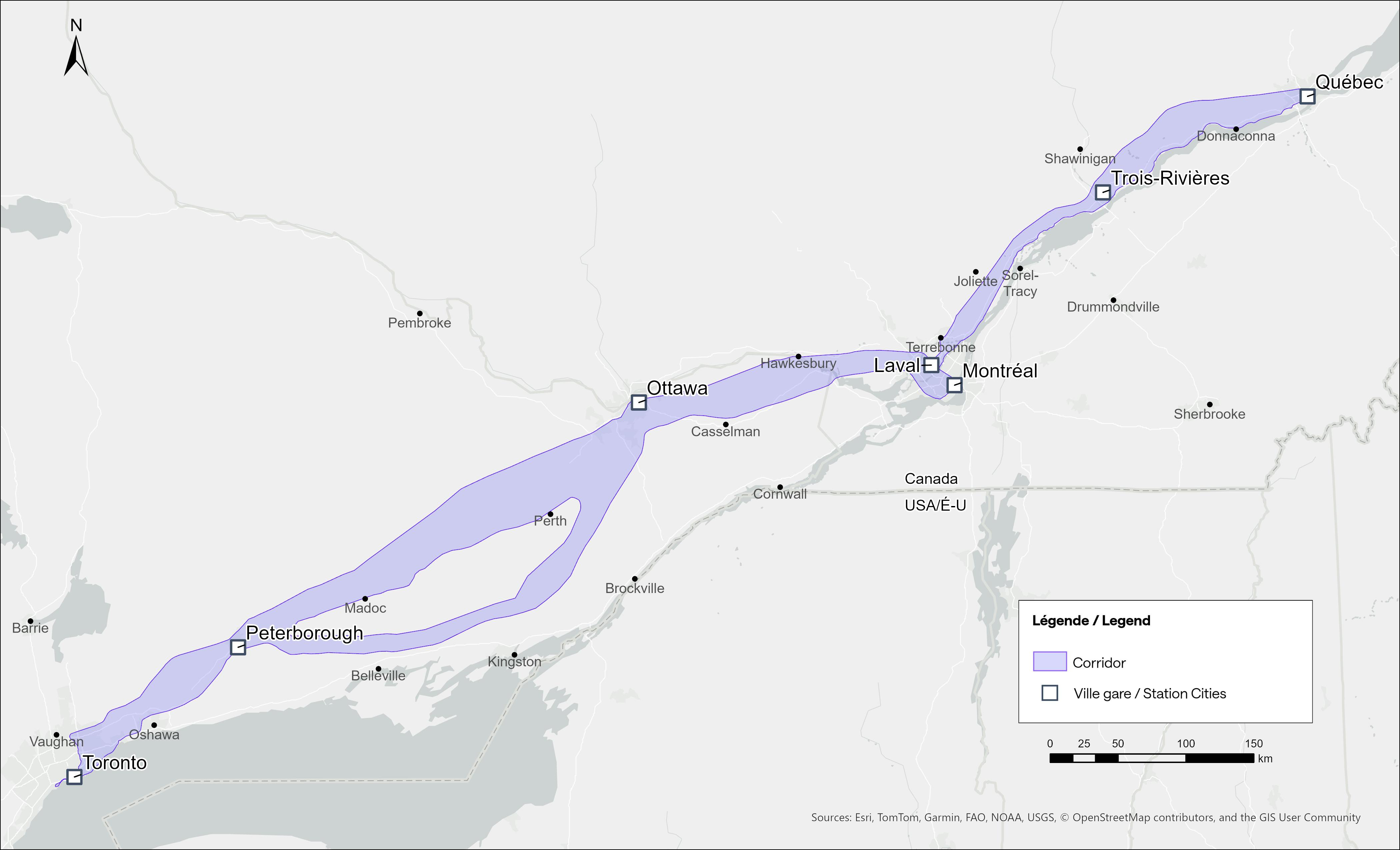
There’s also a painful political zig-zag. Because politicians promised a rather small city that it would be on a previous not-high-speed rail service, we are now shaping our plans for a totally different service around it. You can see some rationality has won out and there is consideration for having an alignment that at least gets a bit closer to Belleville and Kingston, but it would serve these rather important and established travel demand generators with beet field stations just to serve Peterborough (with what would probably also not be a very central station!).
The Quebec City–Toronto political plan makes even less sense given the lack of an airport rail connection in Montreal. High-speed trains would only have to run a short distance west of Toronto to Pearson to connect to an even bigger hub airport, but this option doesn’t seem to be under consideration either.
Canada Doesn’t Know How To Do This
I think the problem with this project is, to some extent, the scar tissue it’s already taken on—the inclusion of Peterborough, for example, though this is mostly an issue due to changes having been made to key project parameters (target speed and budget) but not to the project team’s assumption that the line had to route through the city.
There are also process problems. The project jumped on a structure based on GO Expansion, but that project fell apart due to conflict between Metrolinx and its private-sector partners—presumably related to trying to boil the ocean, attempting to solve too many operational problems at once. This project is even bigger, and while Alto has essentially no experience running trains and planning projects, this is seemingly leading to a different problem: plans that don’t make a lot of sense in the real world!
Ultimately, the issues are bigger than Alto: they are fundamentally tied to faulty governance and our unhealthy P3 obsession (the Ontario P3s have largely been dysfunctional, but mostly for what I would consider to be avoidable reasons. This masks the model’s deeper problems with more basic issues related to infrastructure opening on time and actually working).
Modern transit P3s in Canada started with a bang with the Canada line (CDPQ was notably involved!), which was a great project that functions rather well as a P3. Vancouver wanted an urban transit line from Richmond into the city with an air–rail link, and the partners delivered what mostly feels like just another SkyTrain line. It was a self-contained grade-separated urban transit line.
The sort of “successor” to this project was the REM (CDPQ was also involved here, even more so than it was with the Canada Line), which is also a great project, but one which does legitimately have more problems than the Canada Line. Because the REM has such an expansive scope, there are many more issues with how it potentially uses space in key corridors and key pieces of infrastructure. Additionally, project-related agreements signed in its early stages have limited the REM’s operation of parallel service. Before the REM even opened, this was on full display when plans initially didn’t call for any solid connections to the Montreal Metro. The scale of the project almost allowed it to be treated like an entirely independent transit system that didn’t need to connect with the existing one.
I guess my point is that having one line—or 20% of the lines—in your transit system be some private arrangement seems mostly fine; if there are ever issues, you could always build a new public piece of infrastructure that supplements it. But with the REM, Montreal really created what will be an impossible-to-duplicate regional rapid transit system that ends up looking more like 40% of the city’s rapid transit, and then handed the keys over to a pension fund. That power dynamic is not great, and the way the REM’s stakeholders will want it to be the thing that everything else orbits around is not how you build a rational transit network, especially when some obvious connections—like to VIA at Dorval—were not made or protected for.
You can sort of see how scaling this to high-speed rail creates issues. Now, we aren’t handing a big chunk of the transit system to a private partner, but rather several times more than what even exists today. If you think the REM not connecting to Dorval, or using the Mount Royal Tunnel and the Champlain Bridge, or limiting service expansion on parallel rail routes is concerning, imagine all the ways the nation’s entire high-speed rail system being one giant P3 could create big problems. Paige Saunders created a video recently highlighting one of those big issues: the inability for open access with multiple operators on a brand new high-speed railway—an issue that will probably remain for the rest of this century.
Of course, Alto could be fine—weird infrastructure and routing decisions aside—but there are huge risks. We could end up with a Eurostar-type setup where we chronically experience really low service frequencies with very high fares with service that barely uses the infrastructure that was built at great cost—a sort of rail version of Highway 407. And all of this is because our governments fail to reform, lack vision, and take on serious costs and risks.
Because that really is the problem. While discussing Alto, I’ve frequently heard reference to the major mistakes of other Anglo-world high-speed rail projects—California high-speed rail and HS2 (it would be nice to have Alto openly state what it has actually learned from these projects!). While we might avoid tunneling through open fields, or building a line from Peterborough to Smiths Falls, we appear to be making a totally different mistake: not having control over our critical public infrastructure. For all their problems, CAHSR and HS2, if and when they both finish the relevant jurisdictions, will be able to run whatever service they want and adjust it as time goes by based on demands from the public. This may well not happen with Alto, which will have all manner of contracts underlying it that the public does not have easy access to—part of Canada’s deeply concerning public transparency issues.
Canada could still have hired experts from CDPQ to manage a fully public project, along with consultants from SNCF, but instead we decided to try shifting risk and cost to these parties while losing control. We should have spun up a large federal body to capture common learnings, act as an arbiter, and regulate common issues that are already arising as Toronto builds regional rail—issues that will surely also come up in Alberta, Ottawa, and maybe even Montreal.
So, while the P3 model worked well for the Canada Line, and got the REM built quickly and affordably in a region that was building almost nothing while not really improving what it had, I think the P3 model is going to totally be crushed by the weight of a multi-hundred-kilometre high-speed line.
Regional Railed
You can see a particular manifestation of these problems already forming.
Right now, Metrolinx frequently displays a total lack of regard for intercity rail trains in the way it manages rail traffic on its territory. How might these problems extend to high-speed rail and potentially grow? Will it limit service levels? Restrict speeds? Hurt reliability? Why would the problems associated with the lack of an impartial, higher-level infrastructure-managing authority disappear for Metrolinx and Alto? There are already numerous issues with Union Station in downtown Toronto with different parties being responsible for different sections of the station. How might Alto further complicate this? The fact that Alto (or at least its operations) is not even entirely a government body seems unlikely to help!
And then there are issues in Montreal. A second Mount Royal tunnel really isn’t needed, but if one is built it must be able to accommodate regional trains on the Exo network. But how can Exo itself judge whether the design decisions Alto is making will also work for Exo when Alto doesn’t even have a serious plan to run infrequent all-day trains on its existing network? And how can this tunnel be designed such that it can hook into the Exo network? Taxpayer dollars may be lit on fire as different independent public-rail authorities do battle over their priorities and needs. But, even worse, I can already imagine Alto building its own entirely separate tunnel alignment and terminal in downtown Montreal—meaning Montreal would somehow end up in the insane situation of having two nearby downtown terminals, with tracks leading them in opposite directions, and no connecting tracks (much less service) between them—a huge expense with massive lost value.
What’s crazy is that while Alto seems poised to build its own infrastructure that would be of little use to regional trains in Montreal, it also has seemingly no plans to use the infrastructure of other entities in order to serve other cities in the GTA—like Hamilton and Kitchener–Waterloo—which shows that the problems in governance flow both ways.
Talk is that Alto trains might even go right downtown in Ottawa, which is a neat idea, but one that again feels out of touch with the most rational and cost-effective way to plan the grander Quebec City–Windsor public transit system. Ottawa already has a decent train station with through tracks and a good transit connection to downtown, but because Alto and its private partner are an entirely distinct entity that doesn’t even share a parent organization with OCTranspo or any other transit agency, why would they not want their own parallel route to downtown? It reminds me somewhat of the Gautrain in South Africa, a parallel premium rail service overlaid on poorly-integrated and often-underdeveloped public options.
Now, perhaps these issues are not specifically tied to the project being a P3, but it’s hard to see it that way. The desire to create a fully independent network—one whose design does not prioritize transport connectivity (as evidenced by the lack of airport connections)—combined with the questionable use of public dollars for new infrastructure that would not meaningfully uplift broader public transit, strongly stinks of the issues we’ve seen in other public-private partnerships. The structure of the project now seems to be focused on creating fast trains between cities, not creating a maximally useful public transit network at a reasonable price. While the HFR plans didn’t dream big enough, plans for creating dedicated new rails to downtown Ottawa and a second disconnected Mount Royal tunnel aren’t just dreaming too big, but tripping.
Now, despite what it might sound like, most of these issues are not Alto’s fault—though I do think they could be pressing for changes that would help address some of them, with the exception of the odd routing decisions in Montreal, for which I have yet to see clear justification (if you have, leave a comment and maybe I’ll write a follow-up). The fault is on our governments, which have failed to create a transport agency to coordinate and regulate modern public transit and railway systems—agencies that exist in most other developed countries. Unfortunately, it feels like we want the spoils of the hard political and policymaking work that is needed to create these coordinating authorities (which would go a long way in fixing other problems we have, like stupendously high costs), but without any of the hard work or potential upheaval to the status quo.
Edited by Connor Sziklasi
This project has had the feeling of being too political and too focused on speed and not travel time before it was formally announced, to not leave massive questions. There seems to be too little consideration for what drives trips, and too much on just building tracks that allow fast trains. Airport connections matter both because the trip will often be one leg of a longer trip, but also because airports are already and should be planned to be a hub of far more local transportation, so reaching any final destination that is not the core of the city, might be far easier. Pearson and Trudeau already offer a spot in the western part of their respective cities, which offer a better jumping off point for a very large group of people.
You have to ask, to what degree have the existing alignments been examined for additional tracks straightening and improved crossings? Yes, the existing approaches to Union and Central Station are slow, but why, and can't that be improved? Aren't the current issues with speed and reliability nearly entirely the presence and primacy of freight rail on the tracks, not the maximum running speed because of the geometry of the alignment?
Before we spend $100+++billion on a new route, perhaps we should be looking at what is required to fix the existing alignment, add tracks, and make a reliably sub-3-hour trip between Union and Central Stations. The city pairings of Toronto-Montreal, Toronto-Ottawa, and Montreal-Ottawa should be considered separately to make sure we are not pushing service via Ottawa for Montreal-Toronto trips, just because.
Need to make sure we build something that serves the trips people actually want to make, and that would require it to link well to other services, and focus on total travel time, not top speed. If you are going from Montreal to Toronto, but have to cross the urban portion of the greater Ottawa region at low speed, did you not lose the advantage of a top speed of 300kph? Again, total travel time is what will be key, so in many cases it may be that some of the money would have had more effect on even the long-distance trips, by improving the local services. If it is a struggle to or from Union Station and they are headed to say the west island, it may be that the lack of local services at either end, is what puts someone in their car to begin with.
Through service for Montreal via gare centrale seems tricky. One alternative way to do things might be to break things into multiple services that don't necessarily all reach (or begin in) the city centre.
Montreal - Toronto/Ottawa would run from gare centrale, downtown-downtown (same alignment from the West Island via Dorval into gare centrale as VIA today).
Montreal - Quebec would run from Dorval and branch off onto the EXO 12 Saint-Jerome alignment through Cote-Saint-Luc, along Jean-Talon, and up into Laval, then branching off by autoroute 440 and heading for Trois-Rivieres. Stations (and connections) at Dorval (EXO, REM*), Canora (REM), and de la Concorde in Laval (orange line).
Could also run this as a Toronto/Ottawa - Quebec service alternating with the 'regular' downtown-downtown service, or just have it start/end in Dorval, ideally with a timed transfer to/from Toronto/Ottawa -Montreal trains. Also, could follow the EXO 15 Mascouche alignment with stations (and connections) at Montpelier (REM) and de la Concorde in Laval (orange line).
While that means although Quebec-Montreal wouldn't be downtown-downtown, it would be close and have very good connections to downtown via REM (8min from Canora to gare centrale) or metro (30min from de la Concorde), as well as to everywhere else those systems reach, including dense neighbourhoods, universities, the airport, Laval and the South Shore). Arguably that's better than the Ottawa train station. And while there's additional existing track to follow through the dense city, with some challenges and constraints, it does avoid the really significant tunnel problems caused by trying to get through service via gare centrale.
*Aware that REM isn't planned to run between the airport and the Dorval train station; in this scenario it would be, for airport access and West Island connections.