
Regional Transit Organizations, Please.
The case for less municipal control.

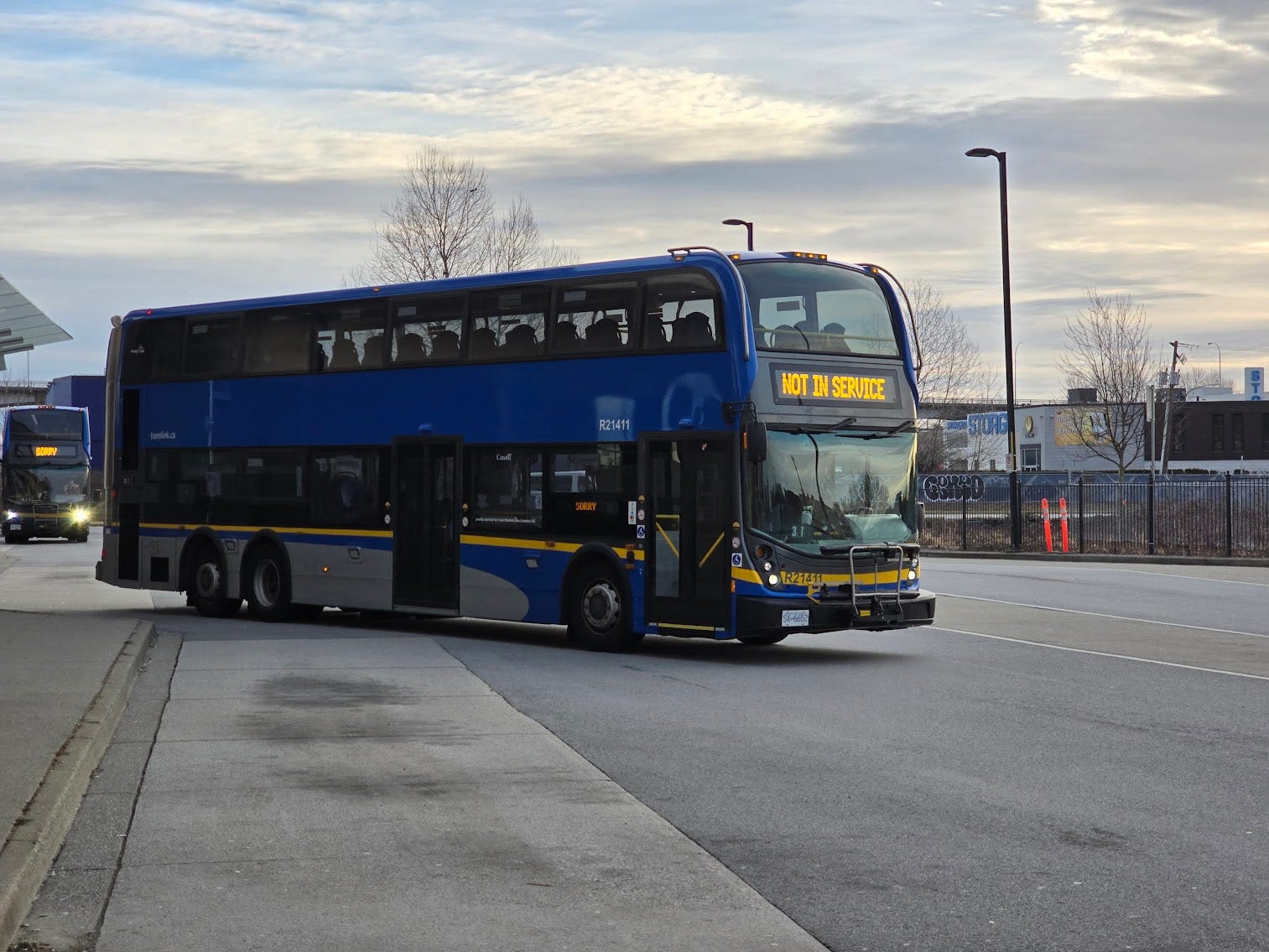
I grew up in Vancouver where transit is a regionally-governed and operated system that connects people on the routes they travel on irrespective of political boundaries — basically just like water, power, or indeed road infrastructure. The public bus I took to high school ran about one hour from end to end and was well used despite crossing three different municipalities.
It was a bit of a shock then moving to Toronto, where there is the Toronto Transit Commission, Mississauga Transit (now generally known as MiWay), Brampton, and York Region Transit (among others). It felt a bit like getting off a plane into a place where there isn’t a minimum wage, or road signs aren’t standardized, or people eat with their feet.

This post is basically about Toronto, but it may as well be about any number of places (some are certainly higher functioning), from New York, to Seattle, or Montreal.
The crazy reality of transit in the GTA is that it frequently just ends at the end of whatever city its operating in, so you can’t just keep taking the same bus down the same old street; buses are tied to cites, so want to take a bus in that city? You’ll need to take that city’s bus.
Part of the cost of this is that we have a whole other agency — GO, which has as part of their job running buses between different cities.
This totally backwards way of operating is representative of many things in Ontario, and is one of the reasons I find it hard to take some transit activism here seriously. Months will be spent so that transit riders can save a few dollars a month on a transit fare, but nobody bats an eye on the much greater cost of shuffling from one bus across a suburban intersection in the rain to wait 20 minutes for another.
A few years ago, we finally got a system of fare integration, so that you at least don’t pay a premium for an often crappy experience, and while that’s obviously an improvement, the screaming about not having a zonal or distance-based fare structure (like Vancouver) and a desire from cities and transit agencies to protect their (rather poor) fiefdoms, means that it’s a janky system of free transfers and inter-agency and government billing instead of a coherent, easily-understood system.
Now, what I am going to suggest is in the eyes of many here radical but, an entirely natural idea — a single regional agency modelled on Vancouver’s Translink.
People in Toronto are really bad about this because they talk about any move to more regionalism as losing the TTC. They seem (despite loudly voicing their opinions on transit issues) totally unaware of the broad and deep dysfunction at the TTC — which has huge issues across its rail systems, poor on-time performance, and a total lack of vision and adaptability. These issues have existed for a long time, and those who have been to other, functional, places know it is obvious. As I like to say, even the TTC logo, which is hard to read and decipher for newcomers and incredibly dated, is symbolic of this.
The other side of the coin of course is a lack of consideration — or interest even, in what could be gained, for me this might even be more frustrating.
Governance
While it’s super boring, unified governance would be huge and hugely important. Instead of important transport decisions that affect the whole region being made diffusely, these would be centralized and could draw on standardized best practice — so that every decision would be to the best standards of the bunch. Decisions being made in secondary parts of the region would no longer need to be so much worse than those in the core.
Region-level governance would also create a clear forum to highlight discrepancies. For example, right now, very little is made of York Region having less than half the transit service of Toronto, because those making the decisions in York only have their own mediocrity to benchmark against. In a regionalized system laggards would get a kick in the butt.
And yet, I don’t think the regional leader in the core — Toronto — would be reduced to some pitiful mean. For one, in the Translink model, Toronto would have disproportionate influence as by far the regions most populous city — it just wouldn’t have absolute power, but this already is the case — the province ultimately calls the shots in our system. Being in the lead would give Toronto outsized influence to set policy and standards, and it might be the motivator to fix its problems, like poor operations and maintenance practices — a detail it might learn from the smaller systems who have been able to maintain discipline and who have had to in a more hostile suburban environ.
Toronto might also be able to better pool resources (and be subject to more political pressure and oversight) to maintain and operate its rail systems, since these were regional assets even before the recent extensions outside the city.
Of course, as part of this, Metrolinx would likely be rolled into this organization, and the province would have a seat at the table, but this would just be acknowledging the reality of the coordination and funding role that the province already takes on and the province’s interest in the transportation system for its biggest urban region that encompasses half its population.
I guess my ultimate argument, especially to Toronto people (and in my eyes this is something the TTC turned away from leading historically, which is a black mark on that agency in my mind) is that it’s better to own a big share of something massive and full of promise, than to have total ownership of something much smaller and broken.
Operations
Of course, a huge benefit to transit regionalization is better operations. The scale of purchasing vehicles, parts, and all kinds of other resources would grow, while the actual things being purchased would standardize. Employees could be more rationally organized, and a larger organization that would combine subway, trams, legacy streetcars, regional trains and all manner of buses would have both a greater breadth and depth of competency.
Being able to operate regionally would also critically allow resources to be used more efficiently. Garages could truly serve a rational geographic catchment with less regard for invisible urban boundaries, and a unified agency could better take advantage of things like lower land costs in outlying areas. It could also formalize existing gentleman’s agreements, doing stuff like sending a bunch of resources to one part of the region for a special event instead of having to negotiate these things every time — an acknowledgement that the “city” is really a region.
A larger agency would support more internal expertise, which would have been a huge asset instead of relying so heavily on private external consultants as the GTA built and builds numerous inter-compatible, but not standardized tram systems from Toronto to Hamilton.
And while there would be “redundancies”, that doesn’t need to mean job losses. Instead of each system having a few sign guys, a large regional agency could have a world-class wayfinding department that does far more with the same resources — and which would inherently produce a regionally standardized system of signs, which obviously should, but does not exist.
Would municipalities lose a direct source of revenue in the form of fares? Yes. But fares already come nowhere close to funding the system, and creating a regional system of collection and distribution would likely be more fair and cost-effective. It could also finally be paired with a rational fare structure for users.
Ultimately, the case here in terms of resources is to stop bickering over the size of your slice and start baking a larger cake.
User Experience
All of this would come down to a better user experience. There are the basic things — like the fact that an agency maintaining twice as many buses is probably better at it, and is better able to field a working bus at any time, or that a bigger organization can both try more new things and try those things in more places, but there’s also the direct benefits to integration.
A regionally-integrated system would work across the region — the way people intuitively expect it to, not unlike roads. People would use the transit system, not a transit system.
Navigating would be made easier still by better, consistent signs and communication, but also by a fare system which provides a consistent and predictable price to riders that aims for fairness while also reflecting the reality of what things cost. The types of services offered would also probably be more clear, with local, express, and regional buses instead of the current mess of numbers, brands, and names that change wildly from one city to another.
If a rider had a problem or wanted an improvement, it would be entirely clear where they should go and who they need to talk to, instead of current transit governance being a mess of different agencies, government bodies, and buck passing.
All of this stuff is possible, but only if those in charge and with influence ask not only what they or their organization might lose, but what they stand to gain.
So a couple of things to remember:
1. Until the megacity, the TTC was a regional transit provider. In the time since, the other regions have grown enormously
2. Any body that crosses regional boundaries would either become a threat to the province (as the original incarnation of Metrolinx was) or subservient to the provincial government
3. Historically, we've had anti-transit, pro-sprawl provincial governments, so Toronto's lack of support for uploading transit (which this would be) is understandable
4. You say you want Translink. The more likely outcome is we'd get SEPTA
Your operations and UX points are good!
Your governance point is bad. You have stumbled into a thorny political problem and are approaching it in a very naive fashion. There is little to no trust between the Province and the GTA municipalities when it comes to transit. Combining these agencies is good on paper, but the creation of said agency would be such a shitshow.
Your snide comment on "people of Toronto" is ugly. We are well aware of the state of the TTC; it is insulting to suggest otherwise. Our distaste for the "regionalisation" is covered in my point above: distrust of Ford and the Province in general. Better the devil you know, until the Province learns to stop meddling